IP :Loading...
Status:Unprotected
VPN Duo logoVPN Duo

Unrestricted Access. Unmatched Privacy.

VPN Duo runs WireGuard, IKEv2, and OpenVPN across a multi-node network, so your traffic stays private without trading away the speed you paid for.

  • AES-256 Encrypted
  • Strict No-Logs Policy
  • WireGuard · IKEv2 · OpenVPN
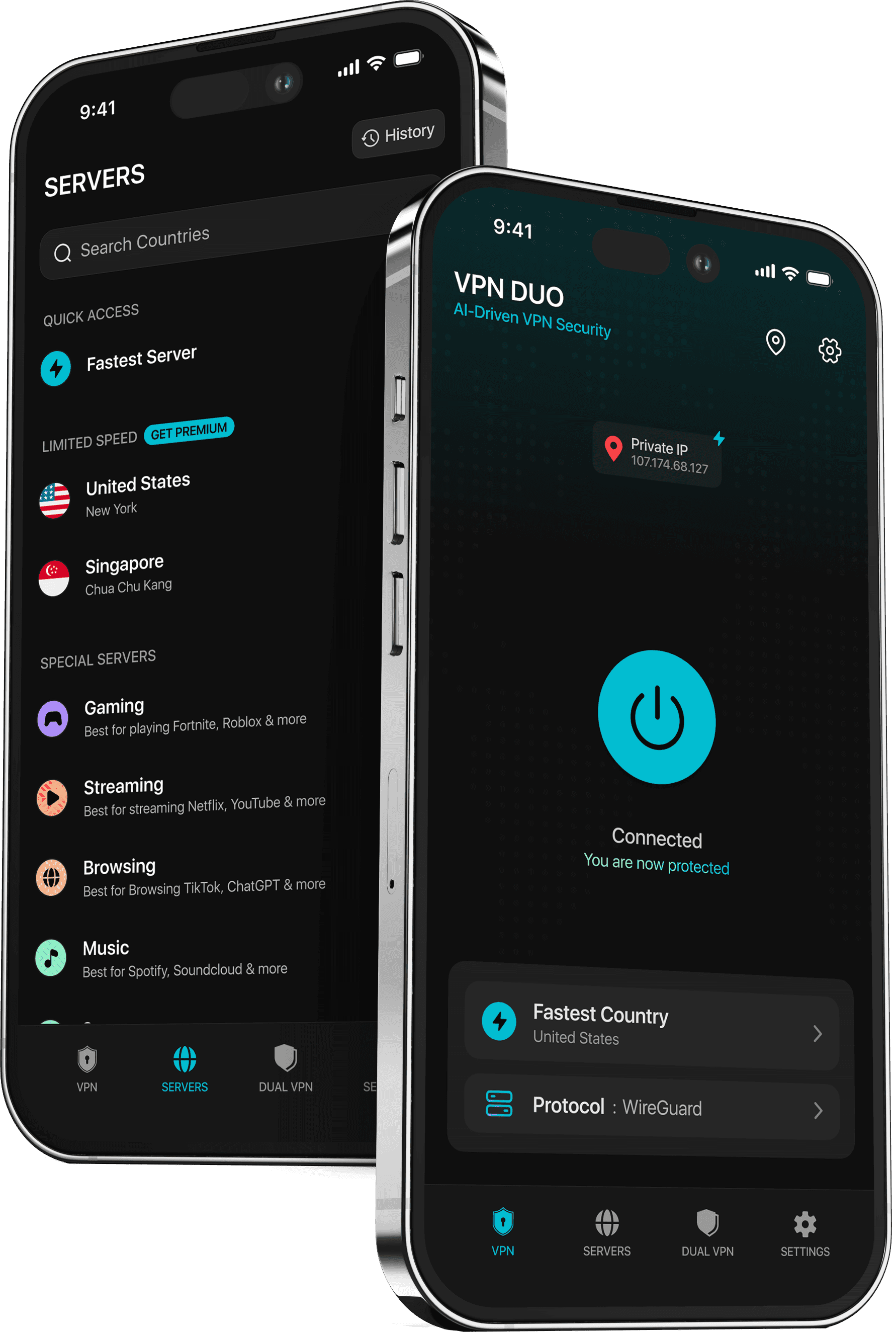
VPN Duo app interface showing available VPN server locations and showing a secure VPN connection

Built on protocols you can inspect

You should not have to take a privacy claim on faith. Here is exactly how VPN Duo moves your traffic.

The modern default

WireGuard

A lean, modern protocol built on a small, auditable codebase. Its short cryptographic handshake means connections come up quickly and survive network changes, so switching from Wi-Fi to cellular does not drop the tunnel.

  • ChaCha20 encryption
  • Fast handshake
  • Roaming-friendly

Built for mobile

IKEv2/IPsec

Natively supported across iOS and Android, IKEv2 excels at re-establishing a tunnel the instant a connection changes. Its MOBIKE support keeps you protected as you move between networks without renegotiating from scratch.

  • Native mobile support
  • MOBIKE roaming
  • Rapid reconnect

Battle-tested compatibility

OpenVPN

Two decades of scrutiny and the widest platform reach of any protocol. Available over UDP for throughput or TCP when you need traffic to traverse restrictive networks that only permit standard web ports.

  • UDP and TCP
  • Audited for 20+ years
  • Broad compatibility

Multi-node routing

Every region runs multiple nodes rather than a single endpoint, so one busy server does not become the bottleneck for everyone connecting there.

Short handshakes

Modern key exchange means the tunnel is up almost as soon as you tap connect, and it re-establishes itself when your network changes underneath you.

Headroom by design

Capacity is provisioned ahead of demand. You are not sharing a saturated link with everyone else who picked the same city.

Ultra-fast servers around the globe

Pick an exit point anywhere on the network.

Advanced Security & Privacy Features

The controls that decide whether a VPN actually protects you — not the ones that only look good on a feature list.

Strict No-Logs Policy

We do not record what you browse, when you connect, or which IP you came from. There is no activity history to hand over, because none is kept.

DNS Leak Protection

Every DNS query is resolved inside the encrypted tunnel on our own resolvers, so your ISP never sees the domains you look up.

Multi-Hop Routing

Chain your connection through two servers in separate locations, so no single node ever sees both who you are and where you are going.

Engineered for Speed

WireGuard by default across a multi-node network, so encryption is not the thing standing between you and your bandwidth.

Unlimited Bandwidth

No usage caps, and no throttling once you cross some unpublished threshold. Stream, download, and game as much as you like.

Simultaneous Devices

One account covers your phone, your laptop, and your browser at once, so you are not signing out of one device to protect another.

Choose the plan that works for you


  • Payments secured by Stripe
  • We never see your card details
  • Cancel anytime

One account. Complete protection.

Sign in once and stay protected across every device you own — including on the public Wi-Fi you would rather not trust.

Frequently Asked Questions

A VPN encrypts your internet traffic and replaces your visible IP address with the address of the server you connect through. That keeps your browsing private from your ISP and from anyone sharing an untrusted network with you — a café or hotel Wi-Fi, for example.

It also lets you reach the internet as though you were somewhere else, which is useful when a service behaves differently depending on where you are connecting from.

No, and you should be skeptical of any VPN that claims otherwise. A VPN meaningfully raises your privacy by hiding your traffic from your ISP and masking your IP address, but it cannot undo everything that identifies you online.

If you sign into an account, accept tracking cookies, or hand over personal details to a site, that site still knows who you are. A VPN protects the connection, not the choices you make over it.

It means we do not keep records of what you do while connected: no browsing history, no connection timestamps, and no log of the source IP you connected from.

The practical consequence is that there is no activity history sitting on our side to lose, leak, or be compelled to produce, because it was never written down.

Encrypting your traffic and routing it through another server always adds some overhead, so a VPN has a real cost — anyone telling you it is free is overselling.

VPN Duo keeps that cost small by defaulting to WireGuard, a modern protocol with a short handshake and low processing overhead, and by running multiple nodes per region so a single busy server is not the bottleneck. Your actual speed still depends on your own connection and how far away the server you pick is.

WireGuard is the right default for most people: it connects quickly and handles switching between Wi-Fi and cellular without dropping the tunnel.

IKEv2 is a strong alternative on mobile, since it reconnects fast when your network changes. Choose OpenVPN when you are on a restrictive network — its TCP mode can traverse connections that block other protocols.

The kill switch cuts your internet connection along with the tunnel. Without it, your device would quietly fall back to your normal, unprotected connection and you might not notice for a while.

It is the difference between a VPN that fails safely and one that fails silently.

A single VPN Duo subscription covers multiple devices at once, so your phone, laptop, and browser can all be connected simultaneously without signing out of one to protect another.